
The World's Best Cities for an Active Lifestyle
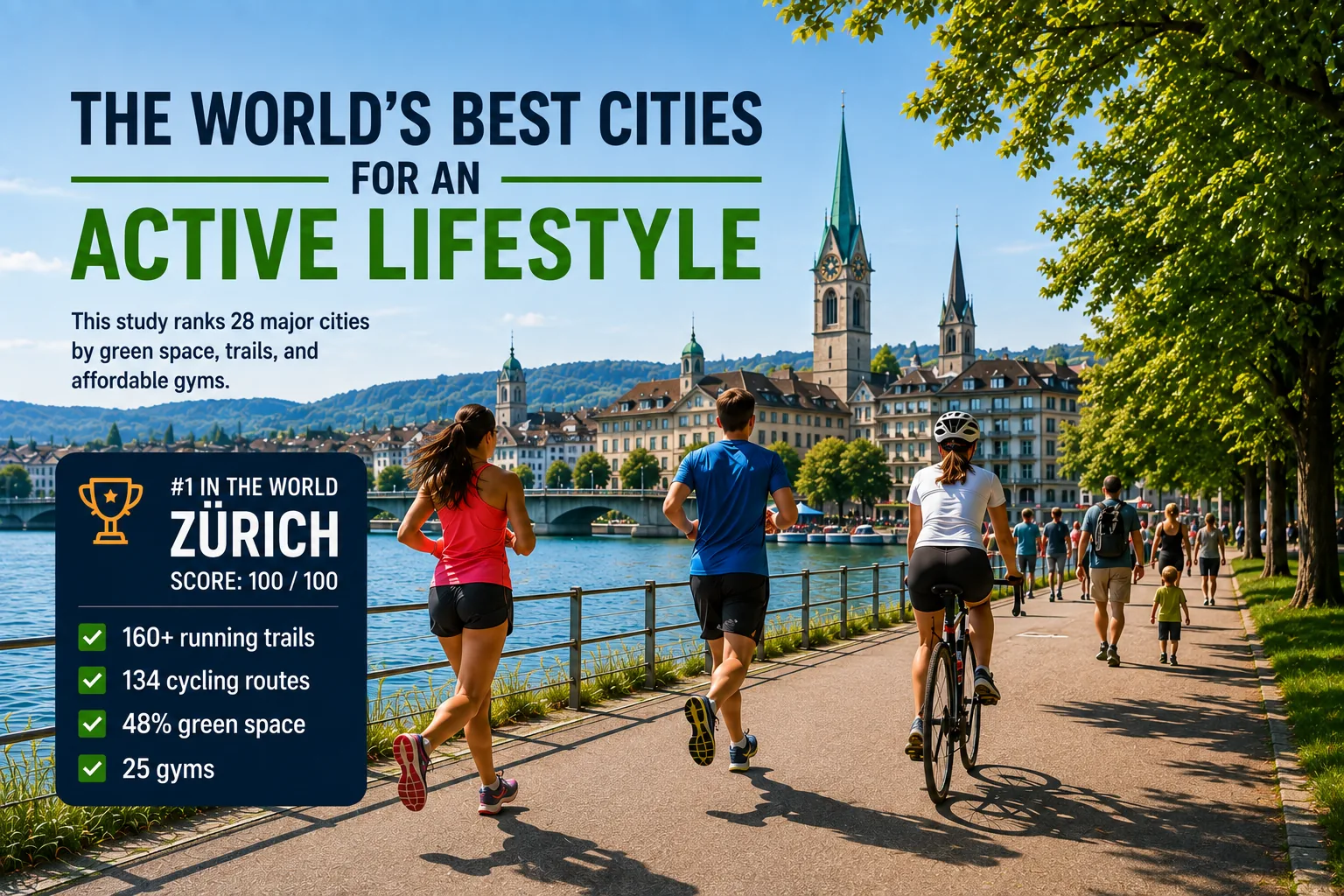
Zürich has just been named the world's best city for an active lifestyle, followed by Brighton. This freshly released August 2026 study by BettingTop10 set out to find the top 10 cities that offer the most green space, running trails, and affordable gyms.
The research looked at 28 major cities across the world and measured how well each one supports an active lifestyle. This included green space coverage, the number of running and hiking trails, cycling routes, and walking paths available to residents. Gym count and monthly membership costs were also considered. These figures were adjusted for city size and combined into a single score out of 100, with higher scores pointing to better conditions for healthy living.
Key Findings
- Zürich, Switzerland, is the world's best city for staying active, offering residents over 160 running trails and 134 cycling routes.
- Two of the US cities are among the best suited for those who care about their physical health, with Charlotte, North Carolina, and Minneapolis, Minnesota, both making the top 10.
- The worst cities for a healthy lifestyle are always large metros, with London, Sydney, and Rome all ranking at the bottom.
Top 10 Cities Best Suited for an Active Lifestyle
|
Rank |
Green Places |
Gym Cost |
Gyms |
Running Trails |
Biking Roads |
Walking Trails |
Final Score |
|
1. Zürich |
48% |
$82.9 |
25 |
164 |
134 |
66 |
100 |
|
2. Brighton |
48% |
$50.4 |
5 |
59 |
5 |
192 |
96 |
|
3. Durban |
62% |
$32.3 |
24 |
13 |
2 |
24 |
93 |
|
4. Bristol |
44% |
$49.0 |
25 |
61 |
10 |
152 |
89 |
|
5. Stuttgart |
56% |
$58.8 |
26 |
87 |
18 |
48 |
85 |
|
6. Charlotte |
66% |
$60.5 |
25 |
54 |
36 |
102 |
82 |
|
7. Dortmund |
54% |
$35.8 |
10 |
42 |
39 |
12 |
78 |
|
8. Minneapolis |
41% |
$64.8 |
55 |
151 |
71 |
178 |
74 |
|
9. Frankfurt |
36% |
$71.3 |
25 |
2 |
1 |
1 |
71 |
|
10. Oslo |
48% |
$59.5 |
25 |
59 |
14 |
68 |
67 |
1. Zürich
Green Places
48%
Gym Cost
$82.9
Gyms
25
Running Trails
164
Biking Roads
134
Walking Trails
66
Final Score
100
2. Brighton
Green Places
48%
Gym Cost
$50.4
Gyms
5
Running Trails
59
Biking Roads
5
Walking Trails
192
Final Score
96
3. Durban
Green Places
62%
Gym Cost
$32.3
Gyms
24
Running Trails
13
Biking Roads
2
Walking Trails
24
Final Score
93
4. Bristol
Green Places
44%
Gym Cost
$49.0
Gyms
25
Running Trails
61
Biking Roads
10
Walking Trails
152
Final Score
89
5. Stuttgart
Green Places
56%
Gym Cost
$58.8
Gyms
26
Running Trails
87
Biking Roads
18
Walking Trails
48
Final Score
85
6. Charlotte
Green Places
66%
Gym Cost
$60.5
Gyms
25
Running Trails
54
Biking Roads
36
Walking Trails
102
Final Score
82
7. Dortmund
Green Places
54%
Gym Cost
$35.8
Gyms
10
Running Trails
42
Biking Roads
39
Walking Trails
12
Final Score
78
8. Minneapolis
Green Places
41%
Gym Cost
$64.8
Gyms
55
Running Trails
151
Biking Roads
71
Walking Trails
178
Final Score
74
9. Frankfurt
Green Places
36%
Gym Cost
$71.3
Gyms
25
Running Trails
2
Biking Roads
1
Walking Trails
1
Final Score
71
10. Oslo
Green Places
48%
Gym Cost
$59.5
Gyms
25
Running Trails
59
Biking Roads
14
Walking Trails
68
Final Score
67
London Has the Most Trails in the Study, and the Worst Score
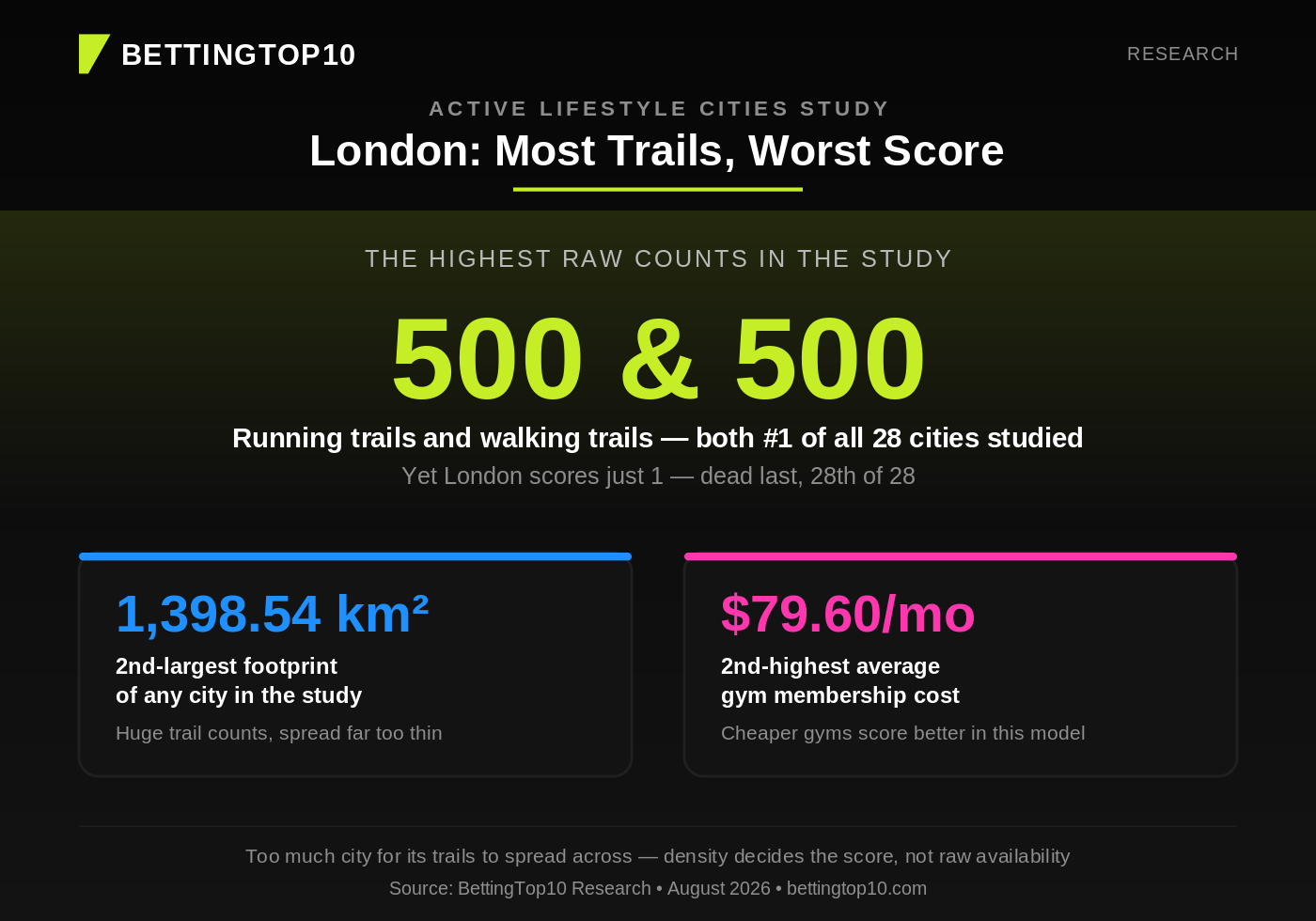
London records 500 running trails and 500 walking trails, the highest raw counts of any city in the entire study by a wide margin. Yet it finishes dead last with a score of just 1. The reason comes down to density, not availability. London's 1,398.54 km² footprint is the second-largest of any city studied, so those huge raw trail counts collapse into some of the lowest density scores once measured per 10 km². A $79.60 average gym membership, the second-highest in the study, compounds the problem further, since lower gym costs score better under this model. London simply has too much city for its trails to spread across.
Top 5 Cities - A Closer Look
1. Zürich, Switzerland
Zürich is the world's best place for an active lifestyle. Despite covering just 80 square kilometers, the Swiss city fits in over 160 running trails and 134 cycling routes, meaning almost everyone here has easy access to outdoor activities. Nearly half the city is made up of parks and green space as well, allowing residents to exercise year-round. Beyond that, Zürich also offers plenty of gyms, where monthly memberships cost roughly $80 a month.
- Green space coverage: 48%
- Running trails: 164
- Biking roads: 134
- Walking trails: 66
- Hiking trails: 228
- Gyms: 25
- Monthly gym membership: $82.90
2. Brighton, United Kingdom
Brighton is the second-best city in the world for healthy living. Residents here have access to nearly 200 walking trails, where they can enjoy morning strolls along the coast. Brighton is also well suited to those who love spending time in nature, with nearly half of the city covered by parks. The city's green spaces are also well equipped, offering around 180 hiking trails that make it easy to stay active while enjoying scenic surroundings.
3. Durban, South Africa
Durban comes next on the list. More than 60% of its total area is covered by parks and natural land, giving residents more room to run, walk, and exercise outdoors than almost any other city. The town also has 13 running trails and 24 walking paths for those who prefer easier routes. For indoor training, Durban offers over 20 gyms near the downtown, and at just $32 a month for a membership, it is the most affordable city for fitness.
4. Bristol, United Kingdom
Bristol ranks fourth for active living. The hiking and walking infrastructure here is among the best in the UK, with 135 hiking paths and more than 150 walking trails, so residents always have somewhere new to explore on foot. Runners are well catered for too, with over 60 dedicated routes available. Beyond its extensive trail network, Bristol also offers 25 affordable gyms near the city center, making it easy to stay active even when it's too cold.
5. Stuttgart, Germany
Stuttgart rounds out the top five with some of the best hiking networks in the world. The German city has over 110 hiking trails running through it, more than Dortmund and Frankfurt combined, making it a natural fit for anyone who loves spending time in the hills. More than half of Stuttgart is green space as well, so parks and open land are always nearby in every neighborhood. Beyond that, the city has plenty of fitness centers that charge under $60 a month.
The Priciest Gyms Don't Guarantee the Worst Scores
Washington, DC has the single highest gym membership cost in the entire study at $113 a month, well above London's $79.60. Yet Washington still outscores London, Sydney, Budapest, and Rome, landing at 19th with a respectable trail density across running, biking, and hiking routes. It's a useful counterpoint to London's result: high gym costs hurt a city's score, but strong trail and green space density can still outweigh that penalty. Cost alone doesn't decide where a city lands.
We may think that staying active comes down to personal motivation, but the research keeps pointing to the same conclusion: environment matters more. Cities that rank highest for active living have walkable streets and green space that's actually accessible rather than concentrated in one or two neighborhoods. When those things are in place, physical activity stops being something people have to plan for and starts being something that just happens naturally throughout the day.
Heather Gartland, Betting Top 10 Analyst
What's Actually Driving These Scores
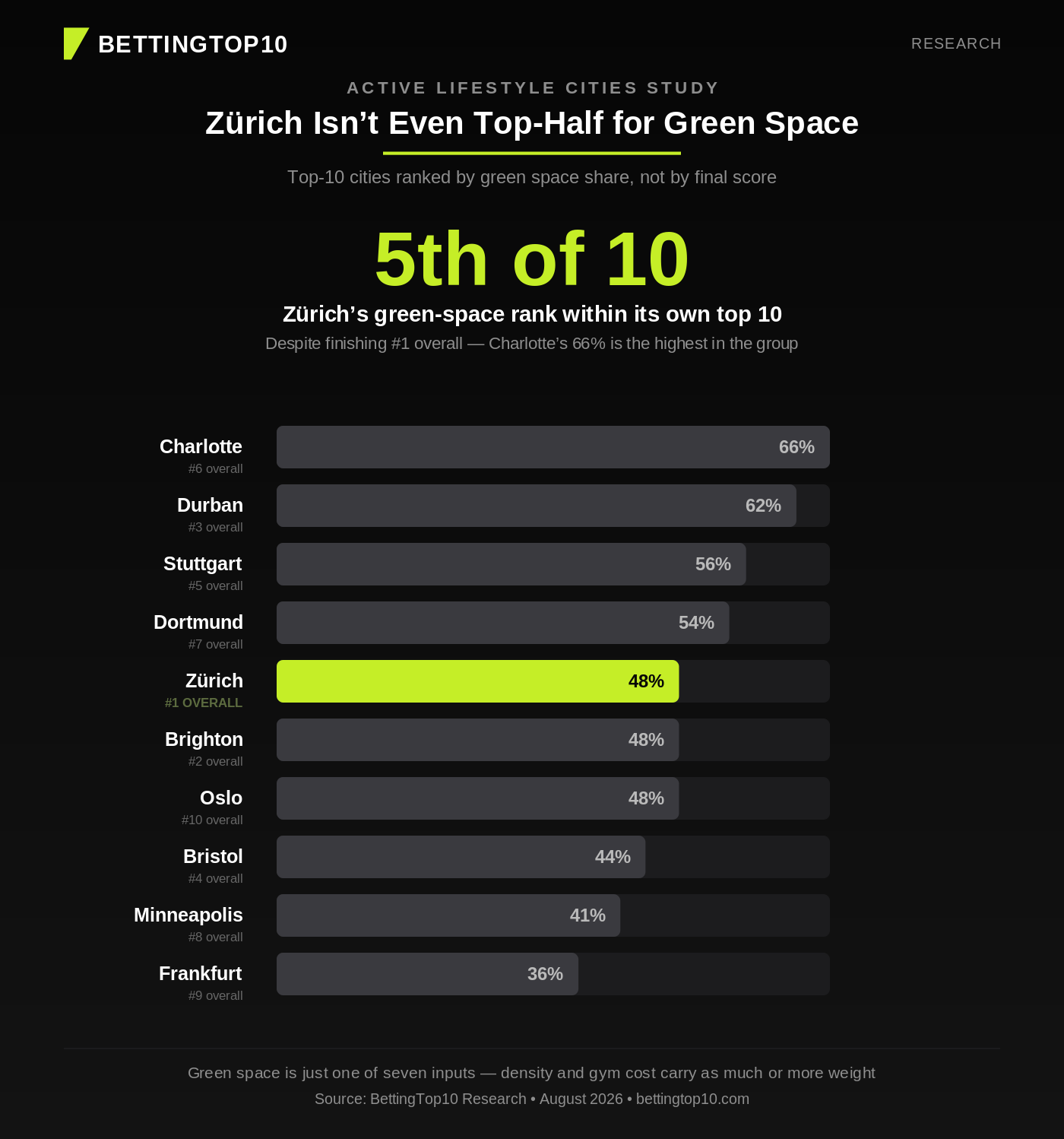
Trail and green space density account for 80% of every city's final score, split across Total Green Places (20%), Gym Membership Cost (20%, reversed so cheaper scores higher), Gyms per 10 km² (20%), and four separate trail-density metrics worth 10% each. That heavy emphasis on density over raw availability explains why some of the most naturally green cities still miss the top 10. Auckland, for example, has 39% green coverage and 162 running trails, yet its low density scores across biking and walking routes hold it to 30th place. Meanwhile, Durban's 62% green coverage, the highest of any city in the study, helps push it to 3rd overall despite offering just 13 running trails, far fewer than most cities ranked below it.
The Complete Field: All 28 Cities Ranked
The countdown above covers the top 10, but the underlying study measured 28 cities in total. Here's how the rest of the field stacks up, from Florence just outside the top 10 down to London at the very bottom.
|
Rank |
City |
Final Score |
|
11 |
Florence |
63 |
|
12 |
Portland |
60 |
|
13 |
Berlin |
56 |
|
14 |
Houston |
52 |
|
15 |
Stockholm |
49 |
|
16 |
Genoa |
45 |
|
17 |
Munich |
41 |
|
18 |
Warsaw |
38 |
|
19 |
Austin |
34 |
|
20 |
Auckland |
30 |
|
21 |
Düsseldorf |
27 |
|
22 |
Prague |
23 |
|
23 |
Washington, DC |
19 |
|
24 |
Johannesburg |
16 |
|
25 |
Rome |
12 |
|
26 |
Budapest |
8 |
|
27 |
Sydney |
5 |
|
28 |
London |
1 |
Worth noting: the bottom three cities, Sydney (5), Budapest (8), and London (1), all have large city footprints that dilute otherwise substantial park and trail networks once density is factored in, confirming the article's claim that “the worst cities for a healthy lifestyle are always large metros.”
Metric Methodology
|
Metric |
Weighting |
|
Total Green Places |
20% |
|
Gym Membership Cost |
20% |
|
Gyms per 10 km² |
20% |
|
Running Trails per 10 km² |
10% |
|
Biking Roads per 10 km² |
10% |
|
Walking Trails per 10 km² |
10% |
|
Hiking Trails per 10 km² |
10% |
|
Total |
100% |
You can access the complete research findings here.

We may think that staying active comes down to personal motivation, but the research keeps pointing to the same conclusion: environment matters more. Cities that rank highest for active living have walkable streets and green space that's actually accessible rather than concentrated in one or two neighborhoods. When those things are in place, physical activity stops being something people have to plan for and starts being something that just happens naturally throughout the day.